Board Brief Nov 2026

Click here to see the PDF version – Recommended

BEFORE THE CALENDAR TURNS 

10 Things Every Florida Community Association Board Should Review Before 2027

As 2026 draws to a close, community association boards have an opportunity to do something that can make a meaningful difference in the year ahead: take stock of where their community stands today.

A successful year-end review isn’t  necessarily about completing every outstanding project. It’s about knowing where things stand and having a clear plan for what comes next.

Whether your association is a small condominium community or a large homeowners association, the following ten areas are worth considering as the year comes to a close.

                                BEFORE THE CALENDAR TURNS                       

10 Things Every Florida Community Association Board Should Review Before 2027

As 2026 draws to a close, community association boards have an opportunity to do something that can make a meaningful difference in the year ahead: take stock of where their community stands today.

A successful year-end review isn’t necessarily about completing every outstanding project. It’s about knowing where things stand and having a clear plan for what comes next.

Whether your association is a small condominium community or a large homeowners’ association, the following ten areas are worth considering as the year comes to a close.


The 10-Point Year-End Review

1  |  KNOW WHERE YOUR FINANCES STAND

Before closing out 2026, compare year-to-date actual expenses against the approved budget, consider significant variances, and review any outstanding financial matters that may carry into 2027.

Boardroom Question: Are there financial concerns we should discuss before the new year?

2  |  MAKE SURE THE 2027 BUDGET IS READY

Adopting a budget is only part of the process. Consider whether homeowners have received, or will receive, clear information on assessment amounts, payment schedules and any significant changes.

Boardroom Question: Will homeowners understand their 2027 assessment obligations?

3  |  REVIEW VENDOR CONTRACTS & PERFORMANCE

Consider upcoming contract renewals, scheduled price increases and any service concerns, and identify contracts that will need attention during the first few months of 2027. Boardroom Question: Are there vendor agreements or service concerns to discuss before the new year?

4  |  REVISIT INSURANCE COVERAGE & RENEWALS

Insurance remains an important consideration for Florida associations. Review upcoming renewal dates and discuss coverage, deductibles or potential changes with your insurance professional.

Boardroom Question: Are there insurance matters we should address with our insurance professional?

5  |  REVISIT RESERVES & CAPITAL PROJECTS

Revisit reserve balances, available reserve studies and significant projects expected next year. Condominiums subject to Structural Integrity Reserve Study requirements should review applicable obligations with the appropriate professionals.

Boardroom Question: Do upcoming capital projects or reserve considerations deserve further attention?

6  |  IDENTIFY UNFINISHED MAINTENANCE ITEMS

Some projects take longer than anticipated. Identifying known maintenance concerns, outstanding projects and needed repairs early can help boards set realistic priorities. Boardroom Question: Are there unresolved maintenance concerns we should revisit?

7  |  REVIEW OWNER COMMUNICATIONS & CONCERNS

Clear communication supports positive relationships between the board, management and homeowners. Consider recurring questions, unresolved concerns or upcoming matters that may benefit from additional communication.

Boardroom Question: Are there community concerns that better communication could help address?

8  |  CHECK RECORDS & ADMINISTRATIVE HOUSEKEEPING

Maintaining association records is a responsibility governed by applicable Florida law. Stay familiar with your officialrecords obligations and consider whether any administrative matters need attention. Boardroom Question: Are there records-related or administrative matters to discuss before year-end? 9  |  PREPARE FOR BOARD TRANSITIONS & MEETINGS

If an annual meeting or election is approaching, revisit upcoming meeting dates, expiring director terms, applicable notice requirements and any preparations that may need attention.

Boardroom Question: Are we adequately prepared for our next annual meeting or board transition?

10  |  IDENTIFY THREE PRIORITIES FOR 2027

Rather than a long list of goals, identify three realistic priorities based on your community’s needs, available resources and long-term plans as a starting point for firstquarter discussions.

Boardroom Question: What three objectives would make the greatest positive difference for our community in 2027?

The Board Brief is provided for general educational purposes and is not intended as legal, accounting, engineering or other professional advice. Association requirements vary.

YEAR-END REVIEW Discuss potential concerns before they become urgent.

A LITTLE PREPARATION

Taking time to discuss potential concerns before they become urgent can help boards make more informed decisions.

Year-end is an ideal opportunity to consider the association’s financial position, property conditions, homeowner communications and priorities for the coming year.

Between budgets, maintenance projects, vendor contracts and homeowner concerns, it’s easy for certain matters to remain on the back burner.

WHERE TO FOCUS

Not every item will apply equally to every community. The goal is to identify the matters most relevant to your association and determine which ones deserve further attention.

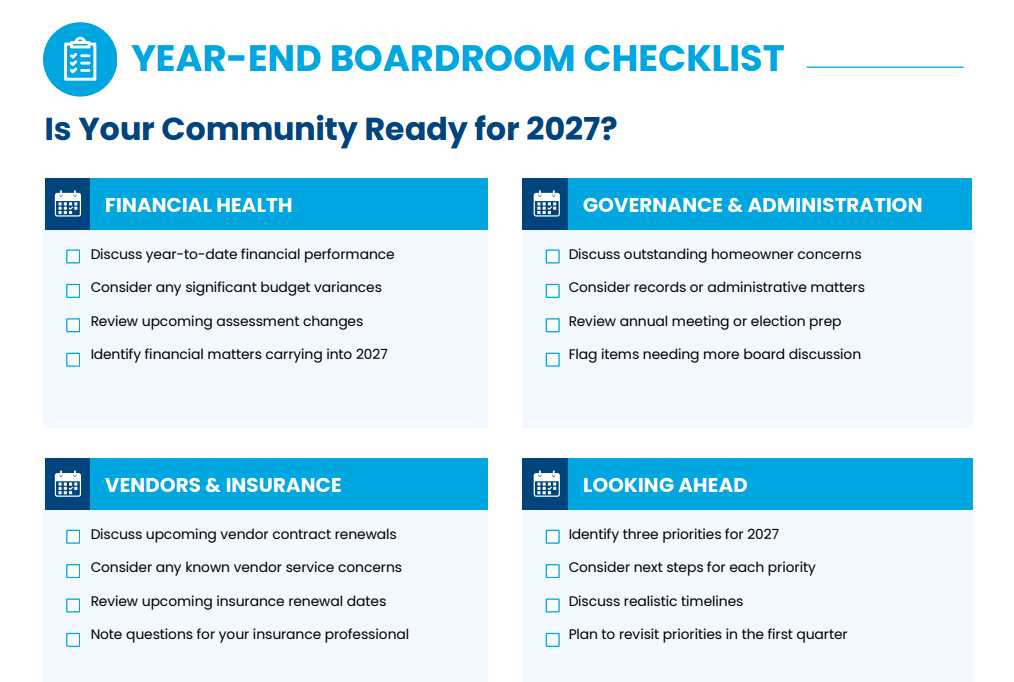
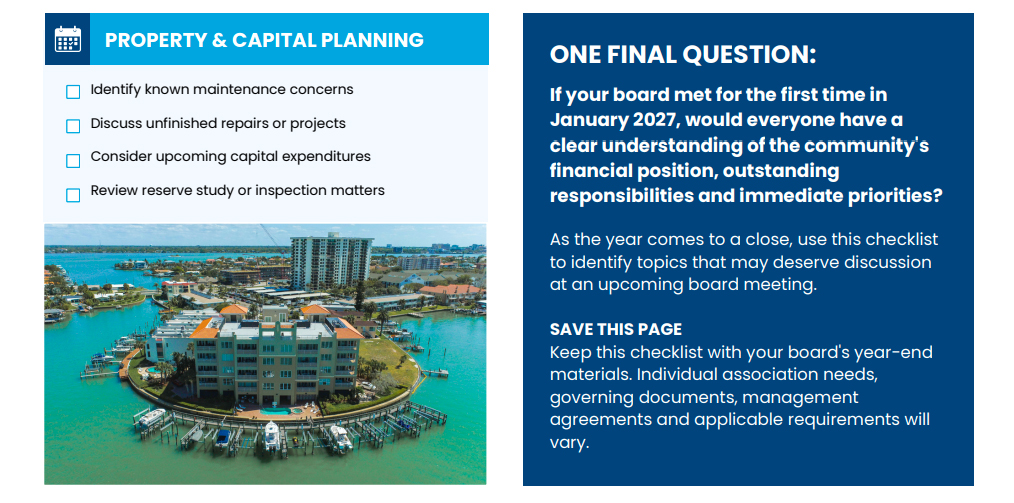
The final weeks of the year offer a valuable opportunity to revisit outstanding items, evaluate what’s working and identify what may need attention before January arrives. Use the 10-point review on page 2 to guide the conversation, and the checklist on page 3 to note topics for your next board meeting.

THE TAKEAWAY

Don’t measure the success of your year-end review by how many items you can check off

MEASURE IT BY HOW WELL YOUR BOARD UNDERSTANDS THE COMMUNITY’S NEEDS HEADING INTO 2027.
ProActive Property Management  offers condo association management services in Palm Harbor, New Port Richey and the entire Pinellas and Pasco County area.

For more information, visit our website at https://proactivefl.com/
or call (727) 942-4755.
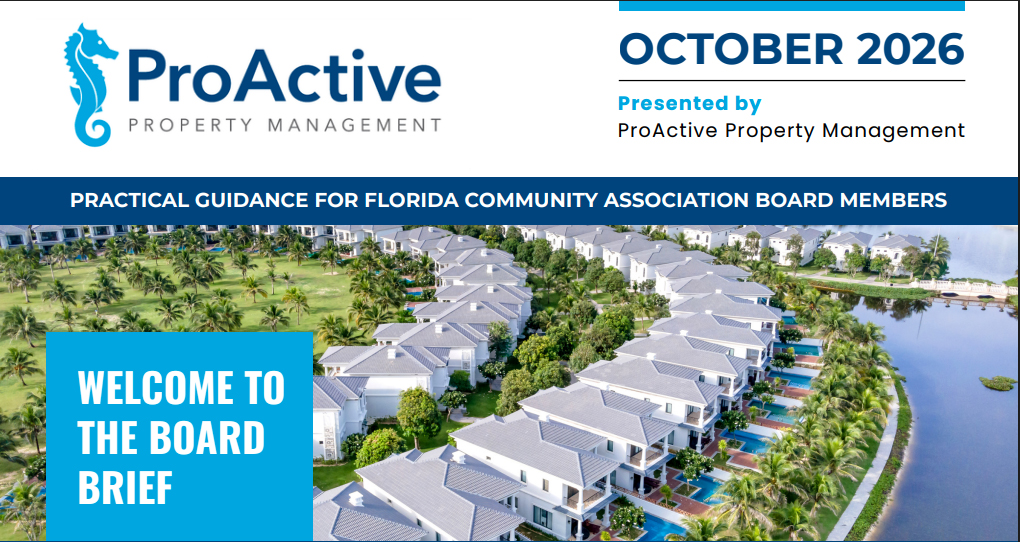
Announcing – the Board Brief

heading


Click here to see the PDF version – Recommended


ANNUAL MEETING SEASON IS COMING

A little preparation now can prevent a lot of problems later.

For many Florida community associations, the beginning of the year means annual meetings, board elections and new directors taking office.

Annual meetings can appear straightforward: send the notice, hold the meeting, count the votes and announce the new board. In reality, a successful annual meeting starts weeks—or even months—before anyone enters the meeting room.

Notice deadlines, candidate requirements, voting procedures, proxies, owner records and governing documents all need to be considered.

Here are five things boards should be thinking about now.2

1. START WITH YOUR GOVERNING DOCUMENTS

Before establishing the annual meeting timeline, review the association’s bylaws and other governing documents.

Confirm:

  • When the annual meeting must occur
  • How many board seats are up for election
  • Length of director terms
  • Quorum requirements
  • Voting and proxy provisions
  • Any association-specific election procedures

Florida law provides the framework, but your association’s governing documents remain an important part of planning the meeting.

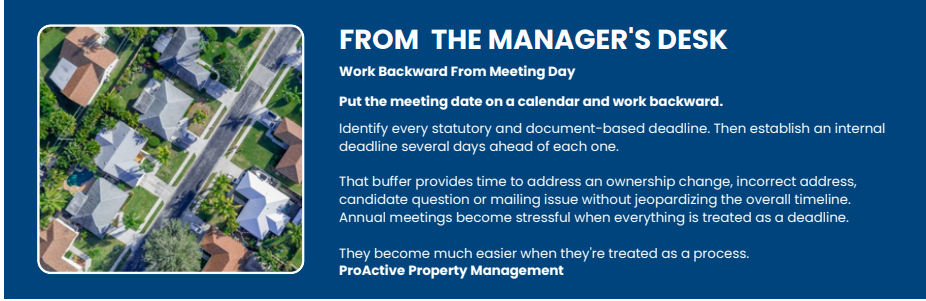
2. BUILD THE TIMELINE BACKWARD

Don’t begin with the first notice. Begin with the annual meeting date and work backward to identify every deadline. For Florida residential condominiums, the election process includes several important statutory milestones:

60 DAYS

First notice of election must be provided at least 60 days before the scheduled election.

40 DAYS

Candidate notices of intent are due at least 40 days before the election.

35 DAYS

Candidate information sheets must be furnished by candidates at least 35 days before the election if they want them included.

14–34 DAYS

The second election notice and ballot are provided during this window before the election.

3. CONFIRM YOUR OWNER RECORDS EARLY

Annual meeting preparation is a good time to review:

  • Owner names and mailing addresses
  • Electronic-notice authorizations
  • Voting certificates, if applicable
  • Ownership changes
  • Eligible voting interests
  • Association roster

Finding a problem three days before the meeting is considerably harder than finding it 60 days beforehand.

4. UNDERSTAND HOWTHE ELECTION WILL WORK

The board and management should know well in advance:

  • Who is eligible to vote?
  • How will ballots be received?
  • Who verifies outer envelopes?
  • Who counts the ballots?
  • When does voting close?
  • How will results be announced?
  • What happens if there are fewer candidates than open seats?

These shouldn’t be questions answered for the first time on annual-meeting night.

5. PREPARE FOR THE MEETING—NOT JUST THE ELECTION

The election is only one component of the annual meeting.

Prepare the agenda, sign-in process, proxies when applicable, reports, ballots, meeting materials, room setup and responsibilities of everyone assisting with the meeting.

A well-organized meeting builds owner confidence.


The best annual meetings often look simple to the owners attending them. That’s usually because THE TAKEAWAY  considerable preparation happened behind the scenes.

BOARDROOM CHECKLIST

Annual Meeting & Election Preparation

60+ DAYS OUT

  • Confirm annual meeting date, time and location
  • Review bylaws and governing documents
  • Determine which board seats are expiring
  • Confirm director term lengths
  • Establish complete meeting and election timeline
  • Review owner roster and mailing addresses
  • Review electronic-notice authorizations
  • Confirm voting certificates, if applicable
  • Determine quorum requirement
  • Review proxy requirements
  • Confirm election procedures applicable to your association
  • For applicable condominium elections, prepare and timely provide the first election notice

40–60 DAYS OUT

  • Track candidate notices
  • Verify candidate eligibility
  • Track candidate information sheets when applicable
  • Begin preparing annual meeting agenda Identify any membership votes requiring additional materials
  • Confirm meeting venue and technology
  • Establish responsibilities for management, board members and other meeting personnel

14–34 DAYS OUT

  • Prepare required second notice/election materials, when applicable
  • Verify candidate names and materials
  • Prepare ballots and envelopes
  • Prepare proxies when applicable
  • Verify mailing list one final time
  • Complete required mailing/delivery
  • Complete required property posting
  • Complete applicable website/portal posting
  • Maintain evidence of required notices

BEFORE MEETING DAY

  • Prepare sign-in sheets
  • Prepare eligible voter list
  • Organize received ballots securely
  • Review proxies when applicable
  • Establish ballot-counting procedures
  • Prepare meeting agenda and scripts
  • Confirm quorum calculation
  • Prepare board/management reports
  • Confirm room layout, microphones and virtual-meeting technology
  • Establish owner-comment procedures
  • Prepare materials for organizational meeting, if applicable

AFTER THE MEETING

  • Announce and document election results
  • Prepare meeting minutes
  • Update board/officer information
  • Complete new-director requirements
  • Update bank and financial authorizations as necessary
  • Update association vendors and professionals
  • Maintain election materials and meeting records as required

CONDO OR HOA? KNOW THE DIFFERENCE  

Florida condominium and homeowners’ association elections do not follow identical procedures.

Know the Difference  Understanding which requirements apply to your association is an important first step.

FLORIDA CONDOMINIUMS

For residential condominiums, Florida law establishes a detailed board-election process, including the notice and candidate deadlines outlined on page 2.

Proxies generally cannot be used to elect condominium directors.

There is no quorum requirement for the condominium election itself; however, at least 20% of eligible voters must cast a ballot for the election to be valid.

FLORIDA HOAS

HOA elections work differently.
Florida law provides that HOA director elections are conducted according to the association’s governing documents.

An election generally isn’t required unless more candidates are nominated than there are vacancies.

Unless otherwise provided by law or the governing documents, HOA members may generally vote in person or by proxy. The governing documents can also significantly affect nomination and election procedures.

For membership meetings, Florida’s HOA statute generally requires at least 14 days’ actual notice when the bylaws do not establish another procedure.

WHY THIS MATTERS

A process that’s correct for a condominium may not be correct for an HOA—and vice versa.

Don’t reuse last year’s packet simply because it worked last year.

Quorum, election participation and the vote needed to approve a membership action can be different requirements—determine each one separately.

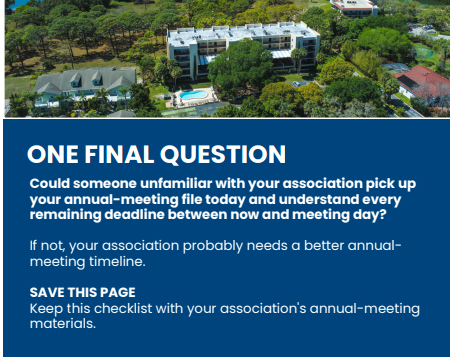
Before beginning annual-meeting preparation, review the current statutes, governing documents and association-specific circumstances.

NEXT MONTH

YEAR-END BOARD CHECKLIST

November’s Board Brief will look at the items boards should have in order before heading into 2027—from financial and administrative housekeeping to contracts, projects and board priorities.

ProActive Property Management  offers condo association management services in Palm Harbor, New Port Richey and the entire Pinellas and Pasco County area.

For more information, visit our website at https://proactivefl.com/
or call (727) 942-4755.
7 Reasons a Condo Association Should Hire a Professional Management Company

Managing a condominium association can be a demanding responsibility. Condo board members must deal with maintenance, finances, vendors, owner concerns, rules, and many other responsibilities while still managing their personal and professional lives. Hiring a professional condo association management company can make these responsibilities much easier to handle.

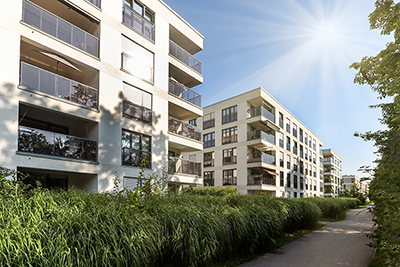
Cityscape of a residential area with modern apartment buildings, new sustainable development and green urban landscape in the city, concept for construction industry and real estate

Here are seven important reasons a condo association should consider professional management.

1. Professional Experience

A professional management company understands the many responsibilities involved in operating a condominium community. Experienced property managers can help boards make informed decisions, organize important tasks, and address problems before they become more serious.

2. Better Maintenance Management

Keeping a condominium property properly maintained protects the community and helps preserve property values. A management company can coordinate routine maintenance, inspections, repairs, landscaping, cleaning, and other services. Having a professional oversee these responsibilities can help ensure that important maintenance issues are not overlooked.

3. Help With Financial Management

Condo associations must carefully manage budgets, assessments, expenses, and reserve funds. A professional management company can assist with financial administration and recordkeeping while helping the board stay informed about the association’s financial condition.

4. Vendor Management

Condo communities often depend on numerous contractors and service providers. A professional manager can help obtain bids, coordinate contractors, monitor completed work, and communicate with vendors. This saves board members from having to personally manage every contractor relationship.

5. Improved Communication With Residents

Communication between a condo association and its residents is extremely important. Property managers can help distribute notices, respond to questions, communicate maintenance information, and keep residents informed about important association matters.

6. Assistance With Rules and Association Responsibilities

Condo associations have governing documents, policies, and responsibilities that need to be properly administered. A professional management company can help the board consistently apply association policies and maintain accurate records. When legal questions arise, the management company can also help the board work with qualified legal professionals when appropriate.

7. Less Work for Volunteer Board Members

Perhaps the biggest advantage of professional management is that it reduces the workload placed on volunteer board members. Instead of spending their personal time coordinating repairs, answering routine questions, contacting vendors, and handling administrative tasks, board members can focus on making important decisions for the community.

Professional Condo Management Can Make a Difference

Running a condominium association requires organization, communication, financial oversight, and ongoing attention to the property’s needs. A professional management company can provide the experience and administrative support necessary to keep the community operating efficiently.

For condo associations that are struggling with management responsibilities or simply want to improve the way their community is operated, professional condo association management can be a valuable investment. The right management company can help protect the property, support the board, improve communication with residents, and make day-to-day association operations much easier.

ProActive Property Management  offers condo association management services in Palm Harbor, New Port Richey and the entire Pinellas and Pasco County area.

For more information, visit our website at https://proactivefl.com/
or call (727) 942-4755.